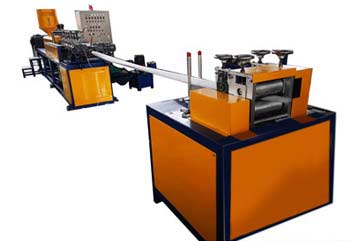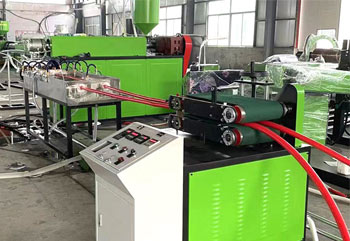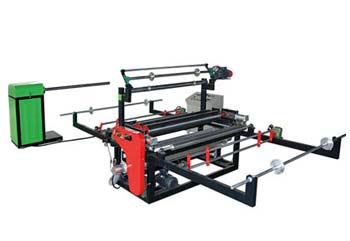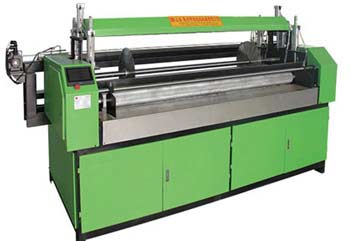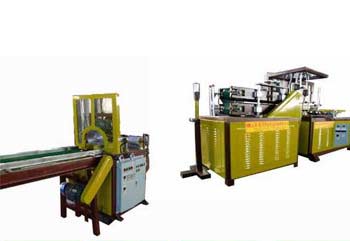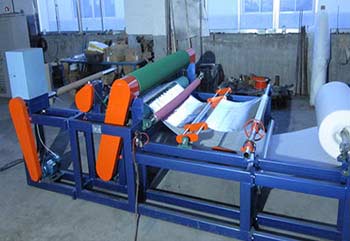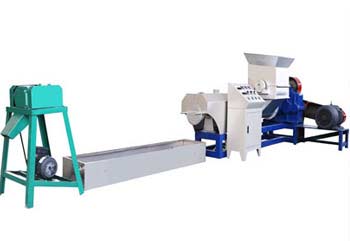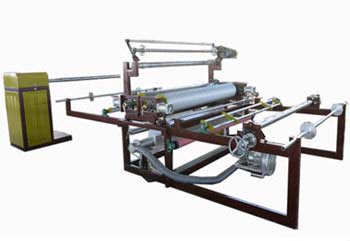
Non‑Crosslinked PE Foam Extruder — EPE/NPE Sheet & Roll Production Line
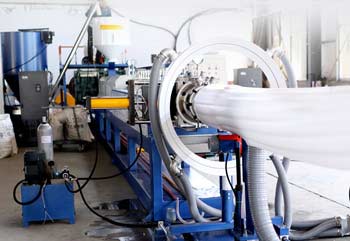
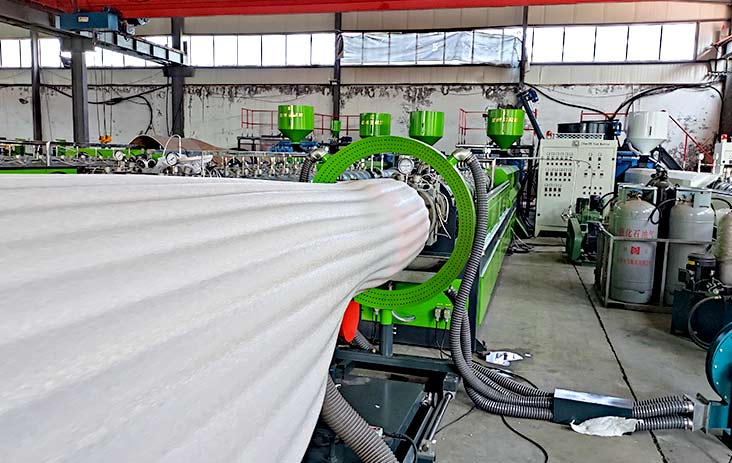
A non‑crosslinked PE foam extruder produces expanded polyethylene sheet by melting LDPE resin, mixing it with a physical blowing agent and nucleating additives, and expanding the melt through a die into a closed‑cell foam web. Because the polymer is not chemically or irradiatively crosslinked, the line is simpler to run for high‑volume pearl‑cotton sheet, roll stock, and downstream lamination/bonding than crosslinked foam lines, while still giving the light weight, cushioning and moisture resistance buyers expect in packaging and insulation.
| Model | Screw dia (mm) | width (mm) | Thickness(mm) | Total power (KW) | Output (kg/h) | Foaming times | Dimension(m) | Weight |
| EFP-75 | 75 | 850~1700 | 0.2-3 | 55 | 25-50 | 9-64 | 20*4*3 | 4T |
| EFP-90 | 90 | 850~1700 | 0.2-4 | 75 | 60-90 | 22*4*3 | 5T | |
| EFP-105 | 105 | 850~1700 | 0.3-6.5 | 95 | 80-120 | 25*4*3 | 5.5T | |
| EFP-120 | 120 | 850~1700 | 0.5-8 | 115 | 120-180 | 27*4*3 | 6T | |
| EFP-135 | 135 | 850~1700 | 1-10 | 150 | 170-220 | 35*4*3 | 7.5T | |
| EFP-150 | 150 | 850~1700 | 2-12 | 220 | 250-300 | 38*7*3 | 10T | |
| EFP-170 | 170 | 850~1700 | 2-14 | 320 | 100-450 | 40*7*3 | 12T | |
| EFP-180 | 180 | 850~2200 | 3-16 | 330 | 300-500 | 41*7*3 | 13T | |
| EFP-200 | 200 | 850~2200 | 3-25 | 400 | 350-650 | 42*7*3 | 14T | |
| EFP-220 | 220 | 850~2200 | 3-27 | 450 | 400-700 | 43*7*3 | 15.5T | |
| EFP-250 | 250 | 850~2200 | 3-30 | 500 | 450-800 | 46*7*3 | 17T |
How the non‑crosslinked EPE line runs
Automatic feeding – LDPE resin and talc/masterbatch are metered into the hopper; additive powders are fed through a separate dosing unit so nucleation and color stay consistent.
Plasticizing in the screw – The single screw melts and homogenizes the polymer. Barrel zones are water/air cooled to prevent feed‑throat bridging; screw geometry is selected for LDPE foam rather than rigid pipe.
Blowing‑agent injection – Liquid butane is metered by a high‑pressure pump into the melt; GMS/anti‑shrink agent is injected separately through a heated metering pump. Non‑return valves protect against backflow.
Die expansion – The gas‑laden melt exits the die lip and expands. Die gap and draw speed set sheet thickness; shaping drum width sets sheet width.
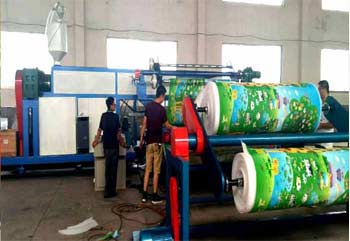
Cooling and shaping – The foam web passes shaping/cooling drums with water/air cooling so cell structure sets and width/thickness stabilize.
Flattening, traction, winding – Haul‑off matches line speed; meter counter controls roll length; surface/centre winder produces finished EPE roll for packing or downstream converting.
For CO₂‑assisted models, the CO₂ injection skid is added to the butane system and tuned for lower‑density or finer‑cell targets; final blend depends on local gas supply and safety approval.
Typical applications
Protective packaging – electronics, appliances, glass, ceramics, furniture edges, export crates; sheet 0.5–10 mm depending on cushion requirement.
Laminated consumer products – baby/camping mats, yoga pads and floor underlay by bonding/laminating EPE with PE film, nonwoven, foil or printed layers.
Construction and insulation – wall/roof/floor underlay, vapor‑barrier composites, pipe‑insulation feedstock; pair with bonding or foil lines for finished systems.
Industrial converting – EPE into profiles, U‑profiles, corner guards, tubes, rods and nets using secondary extrusion/forming equipment.
Specialty grades – antistatic EPE for electronics handling, flame‑retardant EPE for construction/transportation per specified standards, color/masterbatch rolls for retail packaging.
How to specify the quotation
Ask buyers for these six inputs; it turns a vague inquiry into an engineering quote.
Target product – sheet/roll only, or also bonding/lamination/tube/net downstream.
Density and thickness – kg/m³ and mm per layer; single‑pass vs bonded slab.
Width and roll build – finished width, max roll diameter, daily meters or kg.
Resin and additives – LDPE grade/MFI, talc loading, color, antistatic, flame retardant, FR standard (e.g. client market requirement).
Blowing agent – butane only, or butane/CO₂; local gas storage rules and ventilation class.
Plant data – voltage/frequency, cooling‑water capacity, compressed air, building length/height, destination port, Incoterm, target commissioning date.
Example: “EPE roll, 20 kg/m³, 1–3 mm, 1600 mm width, 8 h × 2 shifts, butane only, antistatic optional, 440V/60Hz, UAE” → 105 or 120 mm screw depending on m²/day, butane metering, antistatic dosing option, explosion‑protected panel and FAT on customer density.
Example: “Thick board feedstock, 25 kg/m³, 8–12 mm single pass then bond to 50 mm, 2000 mm width, 300 kg/h, butane/CO₂ optional, FR required” → 150/170 mm screw, stronger cooling drum, CO₂ skid option, FR dosing and downstream bonder interface.
FAQ — Non-crosslinked PE foam extruder (EPE, NPE foam machine)
What is a non‑crosslinked PE foam extruder used for?
It produces expanded polyethylene (EPE/NPE) sheet and roll from LDPE by physical foaming, usually with butane and optionally CO₂. The non‑crosslinked closed‑cell foam is used for packaging, lamination, construction underlay, pipe‑insulation feedstock and downstream profile/tube/net converting.
How is it different from IXPE or XLPE foam lines?
Non‑crosslinked EPE is foamed physically without chemical crosslinking or electron‑beam irradiation, which keeps the extrusion line simpler and well suited to high‑volume sheet and roll. IXPE/XLPE use crosslinking to obtain finer cells, higher temperature resistance and different compression‑set behavior; they require crosslinking/irradiation stages and are quoted as separate lines.
What density and thickness can the line produce?
Reference non‑crosslinked lines cover roughly 13–50 kg/m³ depending on screw size, foaming ratio and formulation. Single‑pass thickness ranges from about 0.2 mm on small screws to 20–25 mm on large screws; thicker slab is made by bonding several sheets. Final range is confirmed by sample formulation and cooling capacity.
Which blowing agent is used?
Most EPE lines use liquid butane metered by a high‑pressure pump. Some configurations add CO₂ or run butane/CO₂ blends for lower density or finer cells. Gas choice also depends on local storage regulations, ventilation and the buyer’s safety permit, so specify the plant location before fixing the gas system.
What screw size do I need for my output?
As a rough reference: 75 mm suits trial/small output around 25–50 kg/h; 105 mm around 80–120 kg/h; 120 mm around 120–180 kg/h; 135 mm around 170–220 kg/h; 150 mm around 250–300 kg/h; 170–250 mm for higher tonnage. Choose by target kg/h at the required density and thickness, not by screw diameter alone.
Is butane handling safe for an export factory?
It can be, with the right design: high‑pressure metering pumps with non‑return valves, ventilated pump/head area, gas‑leak detection, explosion‑protected electrics where required, emergency shutdown and staff training. The exact class depends on local codes; we issue utility/safety requirements after the site layout is known.
Can the line make antistatic or flame‑retardant EPE?
Yes. Antistatic masterbatch and FR additives are dosed through the additive/system; FR grades must be specified by the standard the end customer requires (warehouse, construction, electronics, transit). Do not promise a generic “FR” rating—quote against the named standard and test method.
What after‑sales do you provide for overseas plants?
Factory run‑off with customer resin/additives where logistics allow, export packing, installation supervision, commissioning, PLC/HMI training, English electrical/mechanical manuals, spare‑part list, and remote troubleshooting. List only real certifications—CE/ISO or equivalent—and quote warranty, lead time and Incoterms per contract.
Trust and commercial block
Configuration review based on submitted density, thickness, width, additives and daily output
Pre‑shipment trial report: density check, thickness uniformity, width, roll length accuracy, butane pressure stability
Documentation: line layout, utility load, electrical drawings, gas‑system safety requirements, maintenance schedule, parts list, conformity files on request
Certifications: publish only what your company holds; do not use generic “compliant with all markets” claims
Warranty, lead time, Incoterms and payment terms quoted per configuration
Spare‑part package: screw/barrel wear parts, butane pump seals, GMS pump parts, die lips, heaters, sensors, winder components
HS reference: PE foam extrusion machinery commonly falls under HS 8477.20 or related 8477 series; confirm exact subheading with the importer’s customs broker